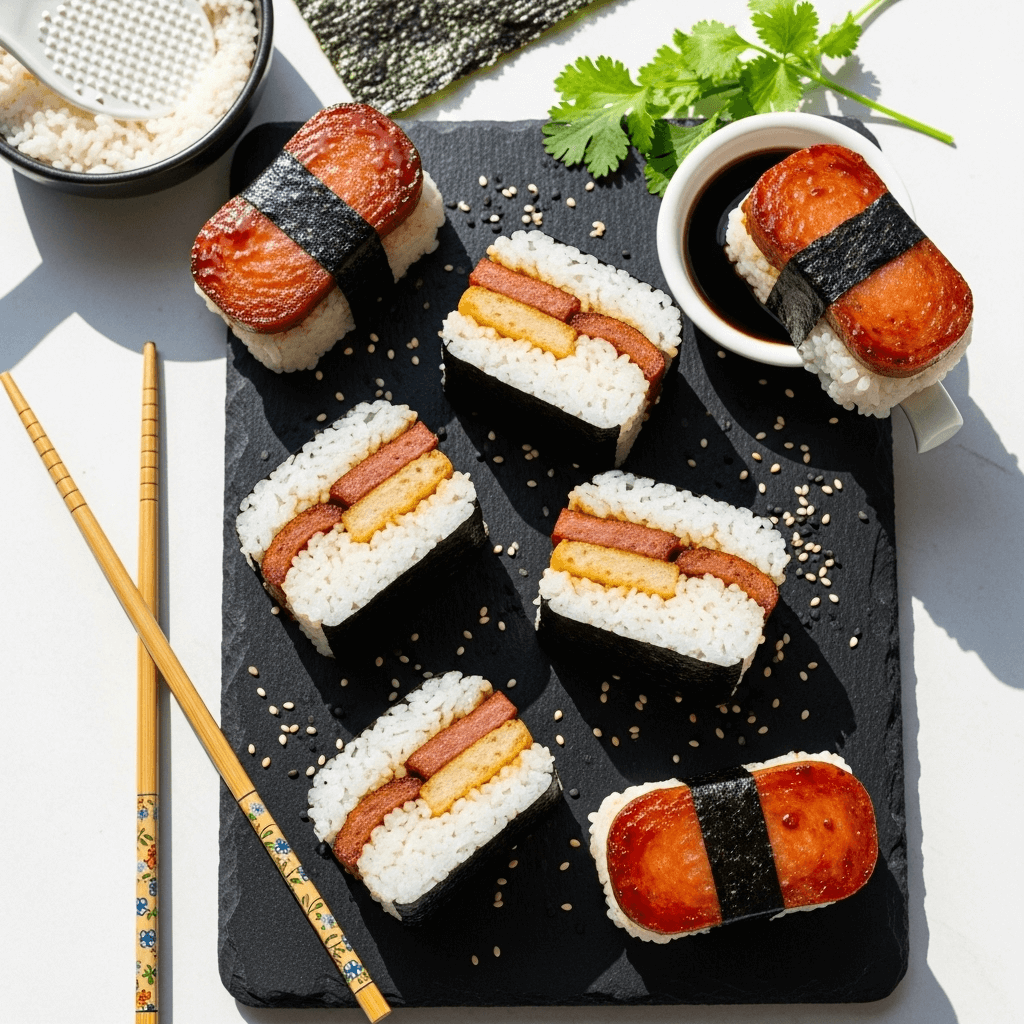
Easy Spam Musubi Recipe – Hawaiian Snack Perfection!

If you’ve never experienced the simple joy of Spam musubi, you’re in for an absolute treat! This iconic Hawaiian snack is the perfect marriage of savory, sweet, and umami flavors – featuring crispy-edged slices of pan-fried Spam glazed in a teriyaki-style sauce, nestled on top of perfectly seasoned sushi rice, and wrapped with a strip of nori (seaweed). Think of it as Hawaii’s answer to the sushi roll, but with a uniquely island twist that’s both comforting and crave-worthy.
Spam musubi has become wildly popular far beyond the Hawaiian islands, and it’s easy to see why. These handheld rice and Spam snacks are perfect for so many occasions – pack them in lunchboxes, serve them at parties, bring them to potlucks, enjoy them as an afternoon snack, or even have them for breakfast (trust me, it’s a thing!). They’re portable, filling, affordable, and absolutely delicious. The best part? This authentic Spam musubi recipe comes together in just about 30 minutes with minimal ingredients and no special skills required. Whether you’re a longtime musubi lover or trying this Hawaiian Spam sushi for the first time, this easy recipe will have you making perfect musubi every single time.
History / Background
Spam musubi has a fascinating history that beautifully illustrates how cultures blend and create something entirely new and wonderful. To understand musubi, we need to look at both Japanese and Hawaiian influences that came together to create this beloved snack.
The story begins with Japanese immigrants who came to Hawaii in the late 1800s to work on sugar plantations. They brought with them the tradition of onigiri – Japanese rice balls often wrapped in nori and filled with various ingredients like pickled plum, salmon, or tuna. Onigiri was the original portable meal, perfect for workers who needed something filling and easy to eat in the fields.
Fast forward to World War II, when Spam (which stands for “Spiced Ham,” created by Hormel Foods in 1937) became a military staple throughout the Pacific. American soldiers introduced Spam to Hawaii, where it quickly became incorporated into local cuisine. Unlike many places where Spam is considered a novelty or last-resort food, Hawaiians genuinely embraced it. The canned meat was shelf-stable, affordable, protein-rich, and actually quite tasty when prepared well – perfect for the islands.
Spam musubi as we know it today likely emerged in the 1980s or early 1990s, though its exact origin is debated. Some credit a Japanese-American woman who combined her cultural heritage with available local ingredients. Others point to convenience stores and local lunch wagons that began selling these portable snacks to workers and beachgoers. Regardless of who created the first one, Spam musubi quickly became a Hawaiian staple.
Today, you’ll find Spam musubi everywhere in Hawaii – gas stations, convenience stores (7-Eleven in Hawaii has some of the best!), local restaurants, food trucks, and home kitchens. It’s such an integral part of Hawaiian food culture that Hawaii consumes more Spam per capita than any other state in the U.S. – about 7 million cans annually! Spam musubi represents the beautiful fusion of Japanese and Hawaiian cultures, proving that the most beloved foods often come from unexpected combinations and immigrant innovation.
Why You’ll Love This Recipe
This homemade Spam musubi recipe is about to become your new favorite snack, and here’s why it’s absolutely irresistible:
There’s something magical about the combination of crispy, caramelized Spam with its sweet-salty glaze, the subtle tang of seasoned sushi rice, and the umami hit from the nori wrapper. Each element plays a crucial role, creating layers of flavor and texture that work in perfect harmony. Unlike complicated sushi that requires years of training, Spam musubi is wonderfully accessible – if you can cook rice and slice Spam, you can make these!
Here’s what makes this recipe a total winner:
- Super Easy – No special skills, no sushi training required. If you can use a musubi mold (or even a Spam can!), you’re golden
- Ready in 30 Minutes – From start to finish, you’ll have a batch of delicious musubi ready faster than ordering takeout
- Budget-Friendly – Uses affordable, readily available ingredients that cost just a few dollars total
- Meal Prep Champion – Makes multiple servings perfect for lunches throughout the week
- Portable & Convenient – Self-contained, no utensils needed, perfect for on-the-go eating
- Crowd-Pleaser – Appeals to kids and adults alike; always disappears fast at parties
- Customizable – Easy to adjust the sweetness, spice level, or even swap proteins
- Authentic Hawaiian Taste – Tastes just like the musubi you’d buy in Hawaii, right from your own kitchen
- Great for Beginners – Perfect first recipe if you’re new to Hawaiian or Japanese-inspired cooking
- Addictively Delicious – Warning: You won’t be able to eat just one!
Ingredient Notes
Let’s break down each component of this easy Spam musubi recipe and talk about why each ingredient matters:
Spam Classic: The star of the show! I recommend using Spam Classic (the original) for authentic flavor, though Spam Lite or Turkey Spam work if you prefer. Each can contains 6-8 slices depending on how thick you cut them. Don’t knock it until you try it – when sliced thin and pan-fried until crispy with caramelized edges, Spam is absolutely delicious. The salty, slightly sweet, umami-rich flavor is what makes musubi so addictive. No good substitutions here – Spam is what makes it Spam musubi!
Sushi Rice (Short-Grain Rice): This is crucial for authentic texture. Short-grain Japanese rice (like Calrose, Nishiki, or Kokuho Rose brands) becomes sticky when cooked, which helps the musubi hold together. Long-grain rice won’t work because it doesn’t have the same sticky quality. Jasmine or basmati rice will make musubi that falls apart. You can find sushi rice at any major grocery store, and a bag lasts forever.
Rice Vinegar: This is what transforms plain cooked rice into sushi rice. It adds a subtle tangy flavor and helps the rice stick together better. Unseasoned rice vinegar is preferred (you’ll add your own sugar and salt), but seasoned rice vinegar works in a pinch – just reduce the added sugar and salt. Don’t substitute with regular white vinegar or apple cider vinegar; the flavor is too harsh.
Sugar: Balances the vinegar’s acidity and adds a subtle sweetness to the rice. Regular granulated white sugar works perfectly.
Salt: Seasons the rice and enhances all the other flavors. Fine sea salt or table salt both work well.
Soy Sauce: The base of your Spam glaze, providing that essential umami and salty depth. I recommend using regular soy sauce or low-sodium soy sauce if you’re watching your salt intake. Tamari works for gluten-free versions.
Mirin: A sweet Japanese rice wine that adds complexity and glossy shine to the glaze. If you can’t find mirin, substitute with 1 tablespoon of sake or white wine plus 1 teaspoon of sugar, or just use extra sugar with the soy sauce.
Brown Sugar: Creates that sticky, caramelized glaze that coats the Spam. Light or dark brown sugar both work; dark has a deeper molasses flavor.
Nori Sheets: The seaweed wrapper that holds everything together and adds a subtle ocean-y, umami flavor. Buy roasted nori sheets (the same kind used for sushi). They come in packages at Asian markets or the international aisle of most grocery stores. Make sure they’re fresh and crispy, not stale or chewy.
Optional Add-ins: Some people like adding a thin layer of furikake (Japanese rice seasoning), teriyaki sauce instead of the soy-mirin glaze, or even a scrambled egg layer for breakfast musubi.
Equipment Needed
The good news is you don’t need much specialized equipment, though one tool makes life significantly easier:
- Musubi Mold – This rectangular plastic mold is specifically designed for making musubi and costs just $5-10 on Amazon or at Asian markets. It’s the size of a Spam can and makes perfectly shaped musubi every time. However, you can absolutely use a clean, empty Spam can with both ends removed as a DIY mold!
- Rice Cooker or Medium Saucepan – For cooking the rice. A rice cooker is foolproof, but a pot works great too
- Large Skillet or Frying Pan – For pan-frying the Spam slices until crispy
- Small Saucepan – For making the teriyaki glaze
- Sharp Knife – For cutting the Spam can and slicing the finished musubi
- Cutting Board – For slicing Spam and cutting nori
- Small Bowl – For mixing the rice vinegar seasoning
- Rice Paddle or Spoon – For mixing the seasoned vinegar into the rice
- Plate or Tray – For assembling the musubi
- Plastic Wrap – Optional, but helpful for keeping musubi fresh
That’s it! Very basic kitchen tools that you probably already have.
Print
Easy Spam Musubi Recipe
Classic Hawaiian Spam musubi featuring crispy pan-fried Spam glazed with sweet teriyaki sauce, pressed onto seasoned sushi rice, and wrapped with nori. This easy homemade musubi recipe tastes just like the ones from Hawaii!
- Total Time: 30 minutes
- Yield: 8 musubi 1x
Ingredients
For the Sushi Rice:
- 2 cups uncooked short-grain sushi rice
- 2½ cups water
- 3 tablespoons rice vinegar
- 2 tablespoons sugar
- 1 teaspoon salt
For the Spam:
- 1 can (12 oz) Spam Classic
- 2 tablespoons soy sauce
- 1 tablespoon mirin (Japanese sweet rice wine)
- 1 tablespoon brown sugar
- 1 tablespoon water
For Assembly:
- 4 sheets roasted nori (seaweed), cut in half to make 8 strips
- Optional: furikake (Japanese rice seasoning) for sprinkling
Instructions
- Cook the Rice: Rinse the sushi rice in a fine-mesh strainer under cold water, swirling with your hand, until the water runs mostly clear (this removes excess starch). This takes about 2-3 minutes. If using a rice cooker, add the rinsed rice and 2½ cups water, then cook according to manufacturer instructions. If cooking on the stovetop, combine rinsed rice and water in a medium saucepan, bring to a boil over high heat, then reduce to low, cover, and simmer for 15 minutes. Remove from heat and let sit covered for 10 minutes to steam.
- Season the Rice: While the rice cooks, mix together the rice vinegar, sugar, and salt in a small bowl, stirring until the sugar dissolves completely. Once the rice is done, transfer it to a large bowl and gently fold in the vinegar mixture using a rice paddle or wooden spoon. Use a cutting and folding motion rather than stirring to avoid making the rice mushy. Let the rice cool to room temperature, covering with a damp towel to prevent drying out.
- Prepare the Spam: Open the Spam can and slice the Spam lengthwise into 8 equal slices (about ¼-inch thick each). If you’re using the empty can as a mold, wash it thoroughly and remove both ends carefully with a can opener.
- Make the Glaze: In a small bowl, whisk together the soy sauce, mirin, brown sugar, and water until the sugar dissolves. Set aside.
- Pan-Fry the Spam: Heat a large skillet over medium-high heat (no oil needed – Spam has enough fat). Add the Spam slices in a single layer and cook for 2-3 minutes per side until golden brown and crispy at the edges. You’ll see the edges caramelize beautifully.
- Glaze the Spam: Reduce heat to medium-low and pour the soy sauce glaze over the Spam slices in the pan. Let it bubble and reduce for 1-2 minutes, flipping the Spam once to coat both sides. The glaze will thicken and become sticky. Remove from heat and set aside.
- Prepare Nori Strips: Cut each nori sheet in half so you have 8 long strips. Lay them shiny-side down on your work surface.
- Assemble the Musubi: Place your musubi mold (or empty Spam can) in the center of a nori strip. Wet your hands with water to prevent sticking. Add about ½ cup of rice into the mold and press down firmly with the press or the back of a spoon to compact it into a rectangular block about 1 inch thick. The rice should fill the mold completely with a flat, even surface.
- Add the Spam: Place one glazed Spam slice on top of the rice, pressing gently so it adheres.
- Wrap with Nori: Carefully remove the mold by lifting straight up. Fold one end of the nori over the musubi, then fold the other end over, slightly overlapping. The nori should stick to itself (if it doesn’t, dab a tiny bit of water on the edge). Place seam-side down on a plate.
- Repeat: Continue assembling the remaining musubi with the rest of the rice, Spam, and nori strips.
- Serve: Serve immediately, or wrap individually in plastic wrap for storage. If serving right away, you can slice each musubi in half diagonally for easier eating and prettier presentation.
Notes
- Rice Temperature: The rice should be slightly warm or room temperature when assembling – too hot will make the nori soggy, too cold makes it hard to press.
- Pressing Firmly: Don’t be shy about pressing the rice firmly into the mold. This ensures the musubi holds together when you bite into it.
- Nori Freshness: Fresh nori is crispy; stale nori is chewy and tough. Store unused nori in an airtight container with a desiccant packet.
- Spam Variations: Try Spam Lite, Turkey Spam, or even Bacon Spam for different flavors.
- Make it Spicy: Add sriracha or chili flakes to the glaze for a spicy kick.
- Gluten-Free: Use tamari instead of soy sauce to make this completely gluten-free.
- Prep Time: 15 minutes
- Cook Time: 15 minutes
- Category: Snack
- Method: Stovetop
- Cuisine: Hawaiian
- Diet: Gluten Free
Nutrition
- Serving Size: 1 musubi
- Calories: 285
- Sugar: 6g
- Sodium: 670mg
- Fat: 9g
- Saturated Fat: 3g
- Unsaturated Fat: 5g
- Trans Fat: 0g
- Carbohydrates: 40g
- Fiber: 1g
- Protein: 8g
- Cholesterol: 35mg
Tips & Variations
The beauty of homemade Spam musubi is how easily you can customize it to suit your taste preferences or dietary needs:
Spicy Spam Musubi: Add 1-2 teaspoons of sriracha or gochujang (Korean chili paste) to the glaze for a spicy kick. You can also spread a thin layer of spicy mayo (mayo mixed with sriracha) on the rice before adding the Spam.
Teriyaki Style: Use bottled teriyaki sauce instead of making your own glaze – it’s even quicker! Just heat the Spam slices and brush with teriyaki at the end.
Breakfast Musubi: Add a thin layer of scrambled egg between the rice and Spam for a heartier breakfast version. Some people even add a hash brown patty!
Furikake Musubi: Sprinkle furikake (Japanese rice seasoning) generously over the rice before adding the Spam. This adds extra umami, sesame flavor, and often includes dried seaweed and fish flakes.
Avocado Spam Musubi: Add thin slices of ripe avocado on top of the Spam for a creamy contrast to the salty meat.
Kimchi Musubi: Add a small amount of well-drained kimchi on top of the rice for a tangy, spicy Korean-Hawaiian fusion.
Lighter Version: Use Spam Lite or Turkey Spam, and reduce the amount of sugar in the glaze to cut calories and sodium.
Vegan Alternative: Replace Spam with thick-sliced, marinated, and pan-fried tofu or shiitake mushrooms for a plant-based version.
Different Proteins: Experiment with grilled chicken, teriyaki salmon, or even bacon for non-traditional but delicious variations.
Pro Chef Tips
Want to take your Spam musubi from good to absolutely restaurant-quality? Here are professional tricks:
The Rice Texture Secret: The single most important factor in great musubi is properly cooked, properly seasoned rice. It should be sticky enough to hold together but not mushy. Rinsing the rice until the water runs clear removes excess starch that would make it gummy. And that rice vinegar seasoning? It’s not optional – it’s what makes it authentic sushi rice with the right balance of sweet, salty, and tangy.
Master the Press: Press the rice firmly but not so hard you’re smashing it. You want it compact enough to hold its shape when you remove the mold, but still light and fluffy to eat. The perfect pressure is when the rice compresses into a solid block but you can still see individual grains.
Crispy Spam is Key: Don’t rush the Spam cooking! Let each side get properly golden brown and crispy at the edges. This creates textural contrast between the crispy exterior and tender center, and the caramelization adds incredible flavor. The glaze should reduce until it’s thick and syrupy, coating the Spam like a shellac.
Wet Your Hands: Always wet your hands with water when handling the rice. Rice is incredibly sticky and will coat your hands, making assembly frustrating. Keep a small bowl of water nearby and dip your hands frequently.
The Perfect Cut: When cutting musubi in half for serving, use a sharp knife and wipe it clean between cuts. For extra-clean cuts, wet the knife blade slightly. Cut with a gentle sawing motion rather than pressing straight down.
Nori Application Timing: Don’t wrap the nori too far in advance – it can become soggy from rice moisture. If making ahead, keep the rice/Spam portion separate from the nori and wrap just before eating, or wrap in plastic wrap to protect the nori’s texture.
Temperature Control: Medium-high heat for frying creates that perfect golden crust without burning. If your pan is too hot, the Spam will burn before the glaze caramelizes. If it’s too cool, the Spam will steam rather than fry and won’t develop crispy edges.
Common Mistakes to Avoid
Even simple recipes have pitfalls. Here’s how to avoid the most common musubi mistakes:
Using the Wrong Rice: This is mistake number one! Long-grain rice like jasmine or basmati will not work – it’s not sticky enough and your musubi will fall apart. You absolutely must use short-grain Japanese sushi rice. There’s no good substitute. Also, don’t skip rinsing the rice – unwashed rice is too starchy and becomes gummy and clumpy rather than perfectly sticky.
Not Pressing Firmly Enough: If your rice isn’t compressed properly, your musubi will fall apart when you try to eat it. Press down firmly with even pressure until the rice is compact. If you’re using a musubi mold, the press should go all the way down to the bottom of the mold with some resistance.
Soggy Nori: This happens when the rice is too hot, or when musubi sits too long before eating. If making ahead, wrap in plastic wrap to protect the nori from moisture. For crispier nori, you can lightly toast the nori sheets over a gas flame or in a dry pan for 10 seconds per side before using.
Over-Glazing: Too much glaze makes the Spam overly sweet and salty, and can make the musubi messy to eat. The glaze should be just enough to coat the Spam with a thin, glossy layer. If your glaze is pooling at the bottom of the pan, you’ve added too much liquid – let it reduce more before adding the Spam back.
Cutting Musubi While Hot: If you try to cut musubi immediately after assembly while the rice is still very warm, it will compress and become dense, or worse, fall apart completely. Let the musubi rest for 5-10 minutes at room temperature before cutting. The rice sets slightly as it cools, making cleaner cuts.
Storage & Meal Prep
Spam musubi is excellent for meal prep, though there are a few important guidelines for the best results:
Room Temperature Storage: Musubi can safely sit at room temperature for 3-4 hours, making them perfect for packed lunches, picnics, or parties. This is actually how they’re traditionally sold in Hawaii – at room temperature, not refrigerated. The rice texture is best at room temp, and food safety is fine since the rice is acidic (from the vinegar) and Spam is fully cooked.
Refrigerator Storage: Wrap each musubi individually in plastic wrap and store in an airtight container in the refrigerator for up to 2 days. The rice will firm up and become slightly hard when cold. Before eating, let it sit at room temperature for 20-30 minutes, or microwave for 20-30 seconds to soften the rice and make the nori more pliable.
Preventing Soggy Nori: The nori will soften over time as it absorbs moisture from the rice. To minimize this, wrap tightly in plastic wrap to create a barrier. Some people prefer wrapping the nori separately and assembling just before eating for maximum crispness.
Reheating: Microwave for 20-30 seconds on 50% power, or until the rice is softened but not hot. You can also pan-fry the entire musubi (nori and all) in a lightly oiled skillet for 1-2 minutes per side for a crispy exterior. Another option is wrapping in foil and heating in a 350°F oven for 10 minutes.
Meal Prep Strategy: Make a big batch on Sunday and have grab-and-go lunches all week! Store in individual containers or wrapped separately. The rice and Spam components hold up well, though the nori freshness will decline after day 2.
Make-Ahead & Freezer Notes
Planning ahead? Here’s how to prep Spam musubi in advance:
Make-Ahead Components: You can absolutely prep components ahead to make assembly quicker. Cook and season the rice up to 1 day ahead and store in the refrigerator (bring to room temperature before using). Fry and glaze the Spam up to 2 days ahead and store refrigerated. Cut the nori strips and store in an airtight container. When ready to assemble, everything comes together in minutes.
Assembled Musubi: Fully assembled musubi are best eaten within 4-6 hours, though they’ll keep refrigerated for up to 2 days. The fresher, the better when it comes to nori texture.
Freezing Musubi – Possible But Not Ideal: You can freeze fully assembled musubi, but the texture changes significantly. The rice becomes dry and hard, and the nori gets chewy. If you do freeze them, wrap each musubi very tightly in plastic wrap, then place in a freezer bag. They’ll keep frozen for up to 1 month. To reheat, microwave from frozen for 1-2 minutes on 50% power until warmed through. The texture won’t be quite the same as fresh, but it’s edible and still tasty.
Best Freezing Method: If you want to freeze for future use, I recommend freezing the cooked, seasoned rice in portions and the cooked, glazed Spam separately (both wrapped well). Then assemble fresh musubi as needed. The rice defrosts in the microwave in about 2 minutes and can be brought to room temperature.
Party Prep: For parties, assemble musubi 2-3 hours before guests arrive and keep at room temperature, covered with a damp paper towel to prevent drying. This timing gives you the best texture and flavor without the nori getting too soggy.
Serving Suggestions
Spam musubi is incredibly versatile and pairs beautifully with so many sides and accompaniments:
Traditional Hawaiian Style: Serve with macaroni salad (a Hawaiian staple!), fresh pineapple chunks, and a cold can of Hawaiian Sun juice or Spam musubi’s traditional companion – a crisp, cold soda.
Bento Box Style: Create a beautiful Japanese-inspired bento box with musubi, edamame, pickled ginger, cucumber salad (sunomono), fresh fruit, and some chocolate-covered macadamia nuts for dessert.
Light Lunch: Pair with miso soup, seaweed salad, and some pickled vegetables (tsukemono) for a light but satisfying meal that’s full of different flavors and textures.
Party Platter: Cut each musubi in half diagonally and arrange on a large platter. Serve with small bowls of soy sauce, spicy mayo, and wasabi for dipping. Add some colorful garnishes like sesame seeds and sliced green onions.
Picnic Perfect: Pack musubi in a cooler with fresh fruit, veggie sticks with ranch dip, chips, and cold drinks for the ultimate picnic or beach day meal. They travel incredibly well and don’t require utensils!
Breakfast Spread: Serve breakfast musubi (with eggs) alongside fresh fruit salad, Portuguese sausage (another Hawaiian favorite), and Hawaiian sweet rolls.
Beverages: Traditional pairings include green tea (hot or iced), Hawaiian Sun passion-orange juice, Ramune (Japanese marble soda), coconut water, or simply cold water with lemon.
Side Dishes: Consider serving with kimchi, pickled cucumbers, potato mac salad (Hawaiian style with lots of mayo), shoyu chicken, kalua pork, or fresh poi if you want a truly authentic Hawaiian plate lunch experience.
FAQs Section
Can I use regular rice instead of sushi rice?
Unfortunately, no. Regular long-grain rice doesn’t have the sticky quality that holds musubi together. You really need short-grain Japanese sushi rice (like Calrose or Nishiki brands). The starch content is what makes it sticky and perfect for molding. Without the right rice, your musubi will fall apart when you try to eat it.
Do I need a musubi mold?
No, but it makes life much easier! You can absolutely use a clean, empty Spam can with both ends removed as a DIY mold. It works perfectly and is actually the traditional method. Just press the rice into the can, add Spam on top, and push everything out. A proper musubi mold ($5-10) just makes the process a bit more convenient.
Can I make Spam musubi without frying the Spam?
You can eat Spam straight from the can, but it won’t taste nearly as good. Pan-frying creates crispy, caramelized edges and renders out some of the fat, making it less greasy. The glaze also caramelizes better on hot Spam. For the best flavor and texture, definitely fry it – it only takes 5 minutes!
Why is my nori chewy instead of crispy?
Fresh nori should be crispy when you buy it. If yours is chewy, it’s either stale or has absorbed moisture from the rice. Make sure you’re using fresh nori stored in an airtight container. Also, don’t assemble musubi too far in advance – nori softens over time. For crispiest results, assemble within 1-2 hours of eating.
How long does Spam musubi last unrefrigerated?
Spam musubi can safely sit at room temperature for 3-4 hours, which is how it’s traditionally served in Hawaii. The rice vinegar provides some preservation, and both rice and Spam are fully cooked. This makes it perfect for packed lunches and picnics. Beyond 4 hours, refrigerate for food safety.
Is Spam musubi authentically Hawaiian?
Yes and no! Musubi itself is Japanese in origin (onigiri), but Spam musubi as we know it is a uniquely Hawaiian creation that combines Japanese and American influences. It was invented in Hawaii and is deeply ingrained in Hawaiian food culture. You won’t find it in Japan, but it’s everywhere in Hawaii!
Can I make vegetarian or vegan musubi?
Absolutely! Replace the Spam with thick-sliced, marinated tofu that’s been pan-fried until crispy, or use shiitake mushrooms cooked in the same glaze. The rice is naturally vegan (just rice, rice vinegar, sugar, and salt), and nori is seaweed, so the only non-vegan component is the Spam itself.
Conclusion
There you have it – everything you need to make perfect, authentic Hawaiian Spam musubi right in your own kitchen! This easy Spam musubi recipe proves that sometimes the most beloved foods come from the simplest combinations of ingredients. With just rice, Spam, nori, and a quick teriyaki-style glaze, you can create something that’s genuinely crave-worthy and tastes just like the musubi you’d buy at a convenience store in Honolulu.
Whether you’ve been to Hawaii and want to recreate those vacation flavors at home, you’re looking for a unique lunch idea that travels well, or you’re simply curious about this iconic Hawaiian snack, I promise you’re going to love making (and eating!) these. There’s something so satisfying about the crispy-edged, glazed Spam against the slightly sweet, tangy rice, all wrapped up in that umami-rich nori. It’s comfort food at its finest, Hawaiian style!
I’d absolutely love to hear about your Spam musubi adventures! Did you make any fun variations? What did your family think? Have you converted any Spam skeptics? Drop a comment below and share your experience – I read every single one and love hearing from you!
If you enjoyed this authentic Spam musubi recipe, please PIN it to your favorite Pinterest board so you can find it easily whenever that craving hits (and trust me, it will hit often!). Share it with your friends who love Hawaiian food, Asian-inspired snacks, or anyone who appreciates good, honest, delicious comfort food. Now grab that can of Spam and let’s make some musubi magic happen!