Ingredients
Scale
- 4 cups fresh or frozen fruit (strawberries, blueberries, mangoes, peaches, or your choice)
- 1-3 tablespoons honey or maple syrup (optional, adjust to taste)
- 1-2 tablespoons fresh lemon juice
- 1/4 teaspoon cinnamon (optional, great with apples or stone fruits)
- Pinch of salt (enhances fruit flavor)
Instructions
- Prepare Your Fruit: If using fresh fruit, wash thoroughly and remove any stems, pits, or tough skins. Chop larger fruits into chunks. Frozen fruit can be used directly from the freezer.
- Blend Until Smooth: Add all fruit to a high-powered blender or food processor. Add lemon juice and blend on high speed for 1-2 minutes until completely smooth with no chunks remaining. The mixture should be the consistency of a smoothie or thick applesauce.
- Taste and Adjust: Taste your fruit purée. If it’s tart, add sweetener 1 tablespoon at a time, blending between additions. Add optional spices like cinnamon or vanilla if desired. Remember, the flavors will concentrate slightly as the leather dries, so make it taste just slightly sweeter than you want the final product to be.
- Strain if Needed (Optional): If using seedy berries like raspberries or blackberries and you prefer a smoother leather, pour the purée through a fine-mesh strainer to remove seeds. Use a spatula to press the pulp through, extracting as much purée as possible. This step is optional—many people enjoy the added texture and fiber from the seeds.
- Prepare Your Pan: Line a rimmed baking sheet (half-sheet size works best) with parchment paper or a silicone baking mat. Do not use wax paper as it will stick. Make sure your parchment paper is completely flat with no wrinkles for the most even drying.
- Spread the Purée: Pour the fruit purée onto your prepared pan. Use an offset spatula or the back of a spoon to spread it evenly across the entire surface. Aim for about 1/8 to 1/4 inch thickness—thinner at the edges (as edges dry faster) and slightly thicker in the center. The more even your layer, the more evenly it will dry.
- Dehydrate Using Oven Method: Preheat your oven to its lowest setting (170-200°F is ideal). Place the baking sheet on the center rack and prop the oven door open slightly with a wooden spoon to allow moisture to escape. Dry for 6-8 hours, checking every 2 hours. The leather is done when it’s no longer sticky to the touch but still pliable and slightly tacky. It should peel away from the parchment easily.
- Dehydrate Using Dehydrator Method: Pour the purée onto dehydrator trays lined with fruit leather sheets or parchment paper. Set your dehydrator to 135°F and dry for 8-10 hours. Check after 6 hours—the leather is ready when it’s dry to the touch but still flexible, not brittle.
- Cool Completely: Once the leather is done, remove it from the oven or dehydrator and let it cool completely on the baking sheet for 30 minutes. This allows it to firm up slightly and makes cutting easier.
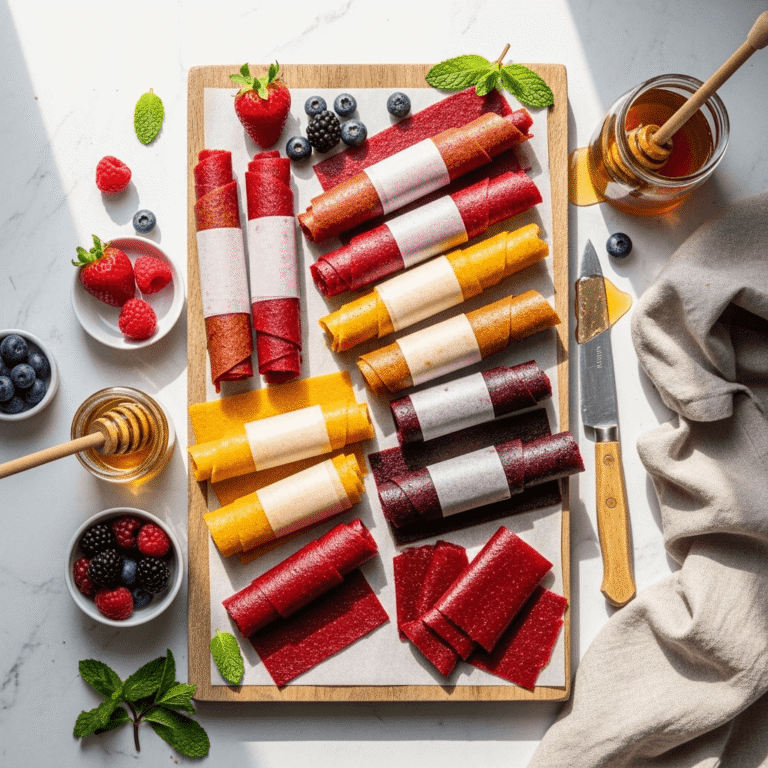
- Cut and Roll: While the leather is still on the parchment paper, use scissors or a pizza cutter to cut it into strips about 1-2 inches wide and 6-8 inches long. If desired, cut pieces of parchment paper the same size and roll each fruit leather strip up with a piece of parchment to prevent sticking.
- Store Properly: Place rolled fruit leather strips in an airtight container or zip-top bag. Store at room temperature for up to 2 weeks, in the refrigerator for up to 1 month, or in the freezer for up to 6 months.
Notes
- Thickness Matters: The key to evenly dried fruit leather is consistent thickness. Use an offset spatula and take your time spreading the purée evenly, making the edges slightly thinner than the center.
- Oven Temperature: If your oven’s lowest setting is above 200°F, leave the door propped open more to prevent cooking the fruit instead of drying it. You want to dehydrate, not bake.
- Don’t Overdry: Fruit leather should be pliable and slightly tacky, not brittle or crispy. If it shatters when you try to roll it, it’s overdried. It will also become slightly firmer after cooling.
- Seed Removal: Removing seeds is personal preference. Seeds add fiber and nutrients but can create a slightly grainy texture. Strawberry seeds are small and unnoticeable; raspberry and blackberry seeds are more prominent.
- Mixture Variations: Try combining fruits for complex flavors: strawberry-banana, mango-pineapple, apple-cinnamon, cherry-vanilla, or mixed berry. The possibilities are endless!
- Testing for Doneness: The leather should be dry to the touch but still flexible. Press your finger into the center—if it leaves an indentation or feels wet, it needs more time. If it feels leathery and peels away from the parchment easily, it’s ready.
- Prep Time: 15 minutes
- Cook Time: 6-8 hours (oven) or 8-10 hours (dehydrator)
- Category: Dessert
- Method: Dehydrating
- Cuisine: American
- Diet: Vegan
Nutrition
- Serving Size: 1 strip (approximately 1 oz)
- Calories: 35-45
- Sugar: 8g
- Sodium: 2mg
- Fat: 0g
- Saturated Fat: 0g
- Unsaturated Fat: 0g
- Trans Fat: 0g
- Carbohydrates: 10g
- Fiber: 1g
- Protein: 0g
- Cholesterol: 0mg